The Adjustment Period No One Talks About
Other than my recent post about starting a podcast, it’s been a couple of months since my last post about leaving my job after 21 years, and that’s because so much has happened. Looking back, what I envisioned before resigning didn’t fully account for the adjustment period—the time it takes to mentally, emotionally, and physically shift into a completely new way of living.
When Things Don’t Go as Planned
When you’ve been following someone else’s system out of necessity for over two decades, you think that when you finally leave, you’re going to hit the ground running. Do all the things you were unable to do because so much of your time and energy was allocated to this one thing. You think you’ll immediately do things your way, become this new version of yourself, and everything will just work. Surprisingly, the reality is — there is an adjustment period. There is a decompression period, and it is not pretty.
It’s been about 3 months, which really isn’t that long to adjust to a completely different life. But when you’re in the middle of it, it feels long. It feels uncomfortable and messy. I still had a little juice after leaving, so I was able to get a few things done, and I think that little bit of energy got me through the new year. After that initial push of energy wore off, everything slowly started to settle in.
A Long Vacation?
At first, it honestly felt like PTO. Like I was just on an extended break. Consciously, I knew I had left. But subconsciously, I was still operating on my old schedule. It felt temporary. As if, at some point, I’d be going back. I’ve taken time off before — a week, maybe two — so there was this underlying, almost automatic expectation that this would follow the same pattern. But then it didn’t. It kept going, and that’s when it started to feel different.
I had to adjust to the idea that I wasn’t obligated to be anywhere at a certain time anymore. I could go to sleep when I wanted. Wake up when I want. Eat when I want. Choose whether or not I wanted to interact with anyone at all. It sounds freeing (in a childlike way)—and it is. Still, it’s also disorienting because what’s really happening is that you’re slowly breaking down a routine that has structured your life for years.
Checks and Balances
Mentally, you know you made the decision. You know you don’t have to go back, but your body doesn’t operate on logic alone. There’s a difference between being consciously aware of a change and your subconscious actually catching up to it. So even though I knew I had left, my body was still running through the old system. It was almost as if it were checking for consequences. If I go to bed late, wake up late, or not follow my usual routine, what happens? Before, there were always consequences tied to those choices. Being late, tired, unprepared, or falling behind.
But now… There weren’t any. Well, not in the way they previously manifested, and that’s where the adjustment happens.
It’s like your body is running through a series of checks and balances, trying to confirm whether the old rules still apply. And little by little, you start to realize—they don’t. You’re not just leaving a job. You’re unlearning a system.
Now, let’s add another layer to this. Depending on how you transition, it can look very different from person to person. However, in my specific situation, I still had a brief period during which I received a regular check. So, it provided a little sense of security, but eventually, that changed. And when it does, you’re faced with a different kind of awareness: There is a finite amount of resources, and your plan B has to kick in. Now I planned for this, putting everything into a financial snapshot template for my advisor to review, but that didn’t make me any less anxious. So, while I’m mentally decompressing, there’s also the pressure of making moves to survive.
Managing My Expectations
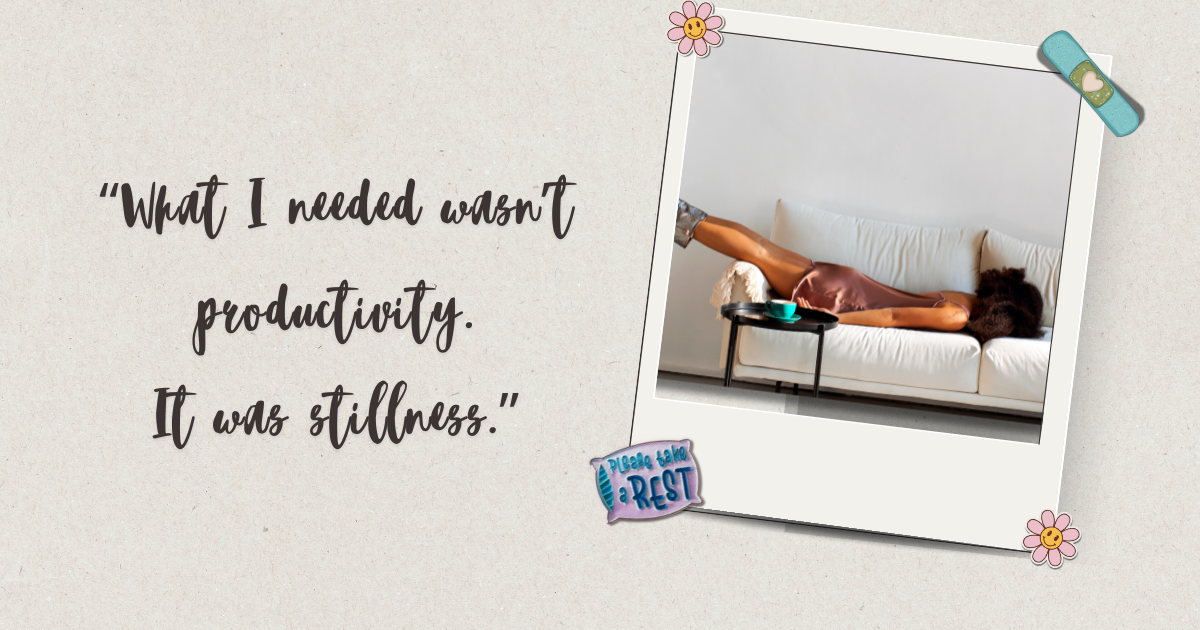
Originally, I had all these plans for what I was going to do. I intended to be super productive, meet with friends, work in cafés, and just be more active, prioritizing my health. I wanted to accomplish all the things I previously lacked time for. However, what I truly needed was stillness. I required time to sit with myself, think, and process everything I had just experienced.
Being naturally introverted, I found myself craving quiet, space, and separation from chaos, rather than constantly being out and about. I allowed myself to embrace that stillness, at least initially. After a while, though, I began to feel like I was idling, while my mind was still very active. I wanted to move, create, and achieve things, but pushing forward often felt overwhelming.
Leaning Into It
So rather than forcing myself, I had to give myself permission to simply be, and that part was essential. Because I allowed myself that space, something shifted. Now, I feel the desire to move again. Not in the same way as before — not rushed, not forced — but intentional. I know I need structure again. I know I need a routine. But this time, I’m building it from scratch. And I don’t yet know what it looks like.
So right now, I’m testing. Trying different rhythms. Different routines. Different ways of working and living. Seeing what actually fits me now — not who I used to be, or what I was used to — but who I am in this current space. And I think that’s where I am now. Not stuck. Not lost.
Just… figuring it out in real time.
I’m sharing this journey as it unfolds—honestly. If you want to see how it evolves, follow along and stay connected. If you want a glimpse into where this mental shift started for me—before I even made the leap—you might resonate with this earlier reflection: Reconnecting and Healing Through Self-Care