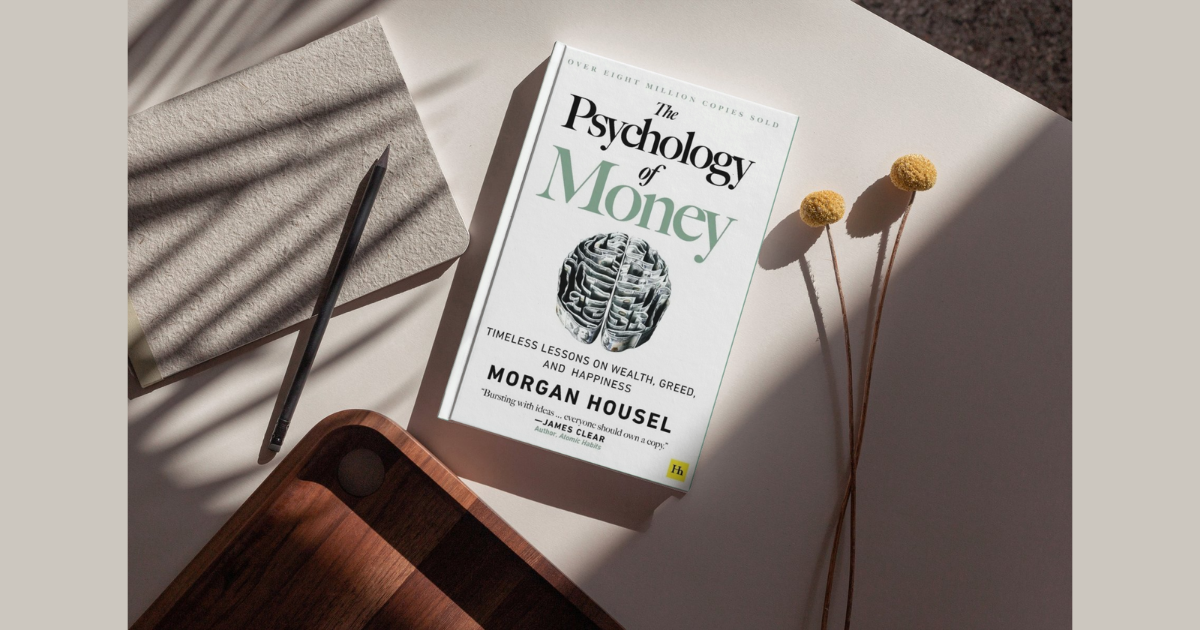
Freedom in Focus: My Reflections on The Psychology of Money
This post contains affiliate links. As an Amazon Associate, I earn from qualifying purchases. If you choose to purchase through my link, it supports my work at no additional cost to you.
In this post, I’m sharing my reflections and review of The Psychology of Money by Morgan Housel. I picked up this book as part of my journey toward becoming financially literate. The book was recommended as a starting point to help me understand my behavior as it pertains to money—specifically, why my spending and saving (or lack thereof) habits are the way they are.
In the past, I’ve tried to budget and save, but I have always been unsuccessful, not because I lacked the resources, but due to my mindset. After some reflection, I realized that I was trying to apply financial practices to an unstable foundation. Initially, my plan was to dive into something more tactical, such as I’ll Teach You to Be Rich by Ramit Sethi. Ultimately, I decided I needed to take a step back and examine the “why” behind my choices. I approached this book with curiosity and openness. I simply wanted to see what would resonate, and surprisingly, I found several points applicable to more than one area of my life.
The Subconscious Side of Money
One of the first things that stood out to me about The Psychology of Money was how Housel often presents two extremes when discussing financial behavior. This reminded me that the goal isn’t to live on one end of the spectrum or the other—it’s to find a middle ground.
“Being mostly reasonable works better than trying to be totally rational.”
That insight really resonated with me. To me, this means finding a balance between saving for the future and actually living and enjoying the present. My challenge has always been delaying reward after sacrifice and fearing that I might delay to the point of never reaping the reward. As you can see, I have my work cut out for me.
“Knowing what to do tells you nothing about what happens in your head when you try to do it.”
That line felt revealing. It’s a simple way to highlight how our internal world—shaped by countless forces, many of which are outside of our control, including generational patterns, cultural norms, and personal lived experiences—ultimately drives our financial decisions.
Early Impressions
Perspective plays a role, too. It reminded me of how my siblings and I all have different relationships with money despite growing up in the same household with the same parent. All of these points drive home Housel’s premise that our spending habits often won’t make sense to anyone but ourselves—and how we cannot fairly judge others’ spending when we can’t possibly understand their internal logic.
The beginning of my fractured relationship with money can be traced back to adolescence, when I first became aware of my family’s financial situation. For me, the realization came when I visited friends and observed how their households operated. That, along with other experiences, ultimately shaped my view of and approach to handling money. If you grow up in an environment where survival is at the forefront—whether physical, emotional, psychological, or any other form that shapes you—your financial decisions might naturally lean toward extremes compared to someone who experienced more stability and security.
Mindset Reset
Housel’s points reached even further after more introspection, revealing what felt like a seemingly inescapable negative feedback loop. The sense of lack, however it manifests, drives decisions that provide short-term, unsustainable relief—only to drop you back at the starting point. You can end up investing your energy in areas that mirror that same instability. When we’re in survival mode, we try to fill emotional or psychological voids in ways that keep us stuck—spending impulsively, staying in unhealthy situations, or making short-term decisions because we can’t yet see the long-term picture.
For me, recognizing this pattern is the first step toward building a healthier, more balanced approach—not just to money, but to life. It made me realize that until I address the underlying scarcity mindset and learn to create stability from within, I’ll keep recreating the same cycles—with money, work, and even relationships.
Be Prepared to Lose Control
Throughout the book, Housel reiterates how you can never be 100% prepared. Life always has an infinite number of moving parts, and many of them are outside of our control. That means it’s not about preparing for anything specific; it’s about just being prepared in general because most of the time, what we anticipate isn’t the reality we’ll actually face.
This stirred up some fears for me. I often worry about not reaching the goals I have for my life. There’s always this quiet anxiety in the back of my mind that reminds me of the fragility of my reality.
Another point he makes is how we look to others for a sense of normalcy. However, the warning here is that our perception is not a reliable depiction of that person’s reality, and imitation without context doesn’t withstand reality. It is safer to ground your actions in what is consistently proven to be true—choosing balance, staying level-headed, yet allowing for flexibility.
This hit home when I looked at my own relationship with saving. Up until now, I’ve never focused on saving. I lived paycheck to paycheck, which left me vulnerable and unprepared for surprises. Instead of being proactive, I was reactive, ultimately limiting my options. Now, as I consider the future and what I’m trying to build, I realize how urgently I need to reframe my mindset. For me, preparedness isn’t about eliminating risk, because that’s unrealistic—it’s about giving myself the flexibility and peace of mind to find my way and live life in a way that resonates with me.
Let’s Address the Void in the Room
Several chapters in this book forced me to question how much of my financial decisions are driven by unresolved issues from my past.
Housel makes the point that many purchases do not actually impress others the way you think they do, if that’s your goal. In fact, when others see your new car, watch, or house, they’re not admiring you—they’re imagining themselves with that item and the potential feeling of fulfillment. For me, my purchases haven’t necessarily been about status. They’ve been more about filling voids and seeking comfort—ways of self-soothing and searching for acceptance.
The point is that, in the end, all you’re left with are more trinkets, the same emptiness you started with, and now the pressure of maintaining this performative behavior. It’s a temporary fix, a brief dopamine hit until that unidentified pit creeps back up to the surface.
You can acquire a new car or house when you don’t need one. After the initial excitement wears off, you are weighed down by the additional financial burden. You can buy new fitness equipment or a new gym membership, but that doesn’t magically create the commitment and consistency needed to get results.
This is why the “moving goalpost” Housel talks about is so dangerous. Suppose you never pause to question these decisions. In that case, you’ll keep chasing the next distraction or crutch, ultimately never reaching a sense of “enough.” The goal is to be honest with yourself about what you need, not just financially, but in terms of your emotional, mental, and personal well-being.
What Does Freedom Mean to You?
Housel states that:
“The highest form of wealth is freedom.”
And I wholeheartedly agree. When I think about freedom, it’s not just about having enough to live comfortably; it’s about having flexibility and autonomy over my days—choosing the activities I engage in, the people I interact with, and being able to step away from environments that don’t align with my values.
I am very thankful to have a job that meets my needs. However, that gratitude doesn’t mask the discontent and growing resentment. The reality is that my ultimate dream is to move away from the dependency on a paycheck and detach myself from spaces that leave me feeling undervalued or energetically drained. I want to live and work in ways that give back to me—not just financially, but also emotionally. Moving forward, I want to dedicate my time, energy, and effort to endeavors that bring about a genuine sense of fulfillment.
Mind Traps
A few of Housel’s points stirred a long-held fear tied to the metaphorical hourglass I associate with aging. They made me realize how often my life has been shaped by the false and rigid barriers I constructed, barriers that kept me from honoring my feelings, values, and aspirations. More than anything, I fear looking back and feeling unsatisfied with what I did—or failed to do.
A significant part of my fear is tied to money. For much of my life, saving was never a priority; I lived paycheck to paycheck, and that dependency felt like its own kind of prison. With the rising cost of living—housing, groceries, utilities, and other essentials—it often feels as though opportunities are shrinking, leaving me to chase money simply to stay afloat. This cycle binds you to corporations and systems that pull you deeper, stripping away freedom piece by piece.
Balancing Freedom
My inability to save wasn’t a conscious rebellion against delayed gratification, but an internal resistance I can only recognize now. Looking back, I see it was driven by fear—fear of sacrificing too much of myself in the present for a future that felt distant and uncertain. Because that future never felt tangible, saving seemed abstract and unrewarding, lacking a clear sense of direction. In truth, my internal compass had already been telling me that I wasn’t aligned with the path best suited for me.
Today, I know the answer is balance. Freedom doesn’t mean denying yourself joy until retirement, nor does it mean spending recklessly with nothing set aside. It means creating a system where saving and living coexist—where I can build security while still rewarding myself along the way. Not with fleeting purchases I’ll soon forget, but with experiences that expand my perspective and bring a richness beyond money. That, to me, is what freedom really means.
Consistency Is the Name of the Game
Consistency really is the name of the game. To me, it’s about showing up for yourself no matter what’s happening around you—not reacting to every distraction or letting chaos throw you off course. Consistency quietly paves the road to your goals, one day at a time.
This isn’t just about money. It’s true in creative work, personal growth, and any long-term pursuit. The key isn’t obsessing over the output, but simply showing up and doing your best with what you have in that moment. No effort is wasted—each attempt builds, compounding into something meaningful over time. Success rarely comes from one breakthrough; it’s the accumulation of steady effort.
Consistency also means resisting mental traps—such as perfectionism, comparison, and the fear of not being enough. I’ve learned the details don’t matter as much as the intention. Show up. Do your best. It won’t always be perfect, but it will always move you forward.
Comparison, in particular, can be one of the most damaging traps. What we see of others is curated—the highlight reel, not the struggle. Everyone starts somewhere, and the only path that matters is your own. Take inspiration, but never let it define your worth.
At the end of the day, consistency is what compounds. Life will throw curveballs, you’ll stumble or pause, but coming back—again and again—is what creates lasting results. Forget perfection. Focus on consistency. That’s where the transformation lives.
The Era of Being Optimistically Realistic
Life has a way of reminding us of our evolution. At different stages, we become different versions of ourselves, shaped by our environments, influences, and experiences. Early on, outside voices and circumstances may steer us. Later, reflection and autonomy start to guide us. That evolution makes planning difficult because who we are and what we value is rarely static.
I’ve seen this in my own path. I changed majors multiple times before settling on my first degree. After graduating, I quickly realized that the field I had chosen did not align with my personality or values. I then pursued a different degree, only to pivot again. Each attempt reflected who I was in that season—and the process is still ongoing. This demonstrates the unpredictability of life.
Due to this unpredictability, it is beneficial to have established practices that can withstand these changes. Something as simple as consistently saving—even modestly—creates flexibility across any stage of life. It’s a reminder that while we can’t control everything, we can develop anchors that keep us steady when things shift.
Negative Noise
Housel reminds us that pessimism often feels smarter than optimism, rooted in our evolutionary history, where organisms that treated threats as urgent were the ones who survived. As a result, our brains are wired to anticipate the worst. Preparing for the absolute worst can appear wise, while optimism can be dismissed as being blissfully unaware.
I’ve caught myself leaning toward pessimism, where things seem far worse than they are, but someone once told me something that stuck:
“There is more good in the world than bad — it’s just that the bad things make more noise.”
That line helped me realize why pessimism can feel so dominant. The noise of negativity—bad news, bad behavior, bad outcomes—tends to drown out the quieter presence of good people and good deeds. Positivity often goes uncelebrated, even though it’s everywhere. In reality, the safer bet lies somewhere between pessimism and optimism. Not leaning so far into blind positivity that you ignore risks, but finding a place where you can acknowledge challenges while still choosing to believe that a better outcome is possible.
Reserved Optimism
For me, optimism is necessary. It’s what keeps me moving. Otherwise, what’s the point of pursuing goals or even getting out of bed? Optimism says: you’ll be okay, you’ll survive, you’ll find a way. Of course, optimism without realism can be dangerous. That’s where being optimistically realistic matters. I try to acknowledge a range of outcomes—good and bad—without letting fear paralyze me. If things go wrong, I remind myself I’ll manage. If things go well, I allow myself to be pleasantly surprised.
Many factors contribute to our ability to remain optimistic, and one of the most influential is the era in which we live. Different periods in history have consistently shaped people’s behavior: wartime often demanded frugality, while times of prosperity encouraged more spending. In many ways, the economic climate governs our choices and, in turn, shapes the mindset—whether hopeful or fearful—that we carry.
Ultimately, despite the external forces of an era, Housel notes that you can choose not to be swayed by uncertainty and instead stay a modest course—one that allows you to thrive despite the circumstances. To me, that reflects what it means to live optimistically realistic: acknowledging life’s fragility, recognizing external influence, but refusing to get stuck in pessimism or pushed into action by fear. It’s about creating your own sense of peace, where you keep moving forward with the belief that better is always possible.
Final Reflections
As an Amazon Associate, I earn from qualifying purchases.
Ultimately, we are all walking our own path, shaped by unique circumstances, values, and experiences. What brings one person comfort or security may not look the same for someone else.
However, the lessons in The Psychology of Money highlight truths that seem universal—messages about freedom, control, consistency, and the deeper motivations behind our financial decisions. For me, reading this book has been about reflection: pausing long enough to ask what really drives my decisions, and how I can align my actions with the life I want to build.
If anything, it serves as a mirror—prompting us to go deeper, to reset, and to create practices that are more supportive and more sustainable for the goals we each hold.
If you’re curious to see how these ideas might resonate with your own story, click the link below to get your copy of The Psychology of Money and discover what lessons Morgan Housel’s perspective brings up for you.
This is only one step in the bigger picture. If you’d like to know why I started Have We Peeked and the story behind it, check out my introduction post.